

By Katelyn Lugo
The Pros and Cons of Meta Automatic Adjustments
Meta Ads Manager continues to lean further into automation, recommendations, and AI-assisted campaign management. For advertisers, that can be helpful, but it can also create new questions. Which recommendations are worth applying? Which should be reviewed carefully? And should businesses allow Meta to automatically make campaign adjustments on their behalf?
In a previous post, we covered the pros and cons of Google Ads auto-apply functions. Meta has a similar concept inside Ads Manager called Automatic Adjustments, along with a related metric called Opportunity Score. Together, these tools are designed to help advertisers identify potential improvements and apply changes more quickly.
For some advertisers, that can save time and uncover useful optimizations. For others, it can create risk if recommendations are applied without enough context. The key is knowing what Meta is trying to do, how these features work, and where human oversight still matters.
At Wahl Media, we view automation as a tool, not a replacement for strategy. A strong paid social campaign still needs clear goals, thoughtful creative, audience understanding, budget control, and ongoing performance review. That is why these features should be evaluated as part of a broader digital media strategy, not treated as a set-it-and-forget-it solution.
What Are Meta Automatic Adjustments?
Meta Automatic Adjustments are recommendations inside Meta Ads Manager that can be applied automatically when Meta identifies an opportunity to improve campaign performance. These recommendations may relate to campaign settings, audience expansion, creative optimizations, placements, budgets, or other performance-related elements.
Meta explains that Automatic Adjustments can apply recommendations whenever there is a chance to improve the performance of your campaigns. Advertisers can set up and manage these adjustments from the Account Overview section of Meta Ads Manager. You can review Meta’s official explanation here: Meta Automatic Adjustments in Ads Manager.
The important word is “automatic.” Once selected, certain recommendations may be applied by Meta without requiring manual approval each time. That can make campaign management more efficient, but it also means advertisers need to be confident that the selected adjustment types align with campaign goals.
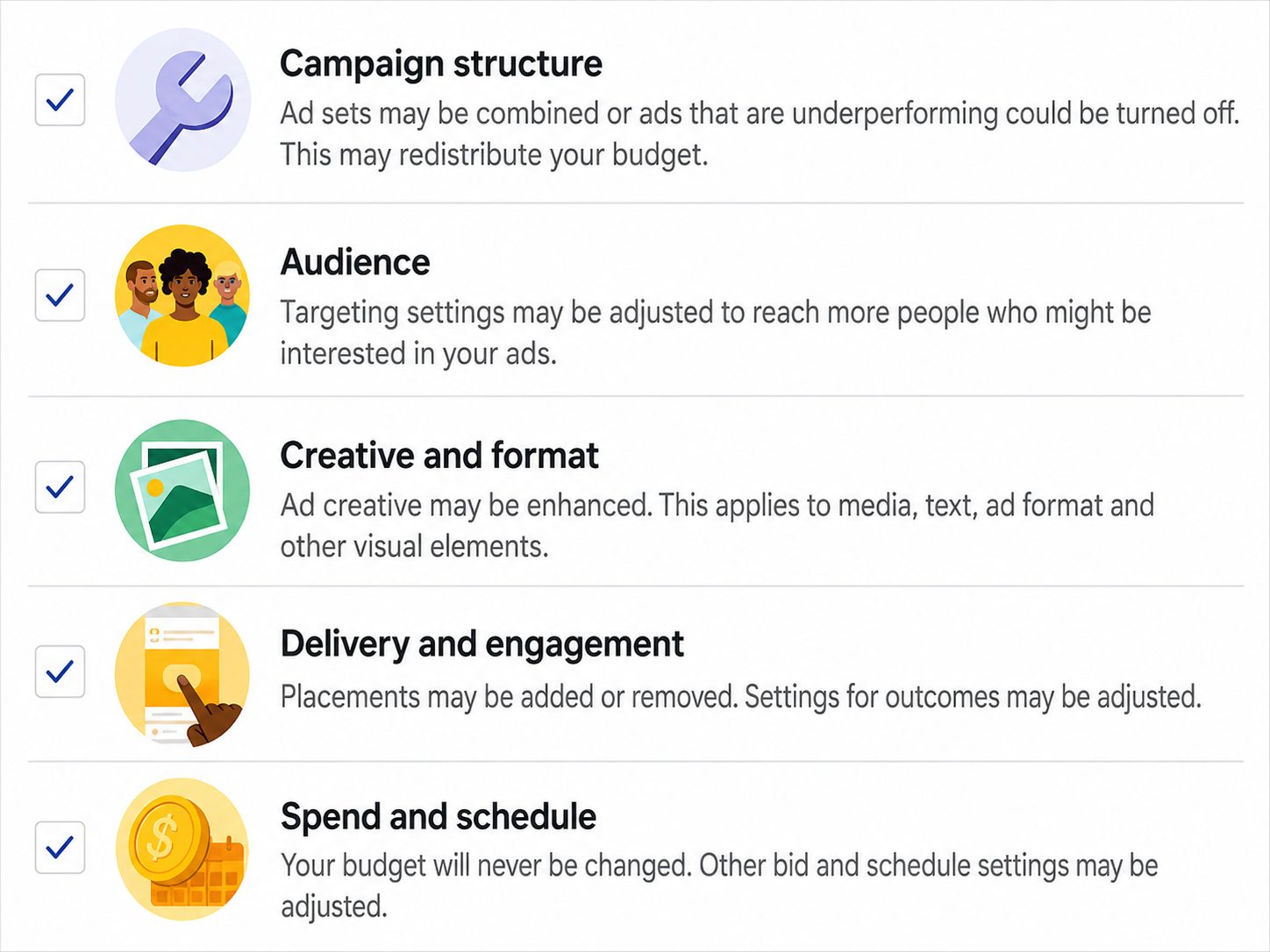
Image source: Meta Ads Manager, Account Overview section
What Is Meta Opportunity Score?
Meta Opportunity Score is a 0 to 100 point score inside Meta Ads Manager. It reflects how many Meta recommendations have been applied and how valuable Meta estimates those recommendations may be for the ad account. Meta says the score is based on how many recommendations you apply, with recommendations ranked by estimated performance impact. You can read Meta’s official overview here: Meta Opportunity Score in Ads Manager.
In simple terms, Opportunity Score is Meta’s way of showing how closely your campaigns align with its current recommendations. If your score is below 100, Meta may show suggested actions that can increase the score. Those recommendations may include changes to campaign setup, delivery, audience settings, creative, placements, or other optimization areas.
However, the score should not be treated as a final measure of campaign health. Meta notes that Opportunity Score itself, including a high score, does not reflect actual or future performance. Actual performance depends on many factors, including campaign objective, budget, audience, creative quality, landing page experience, market conditions, and business goals.
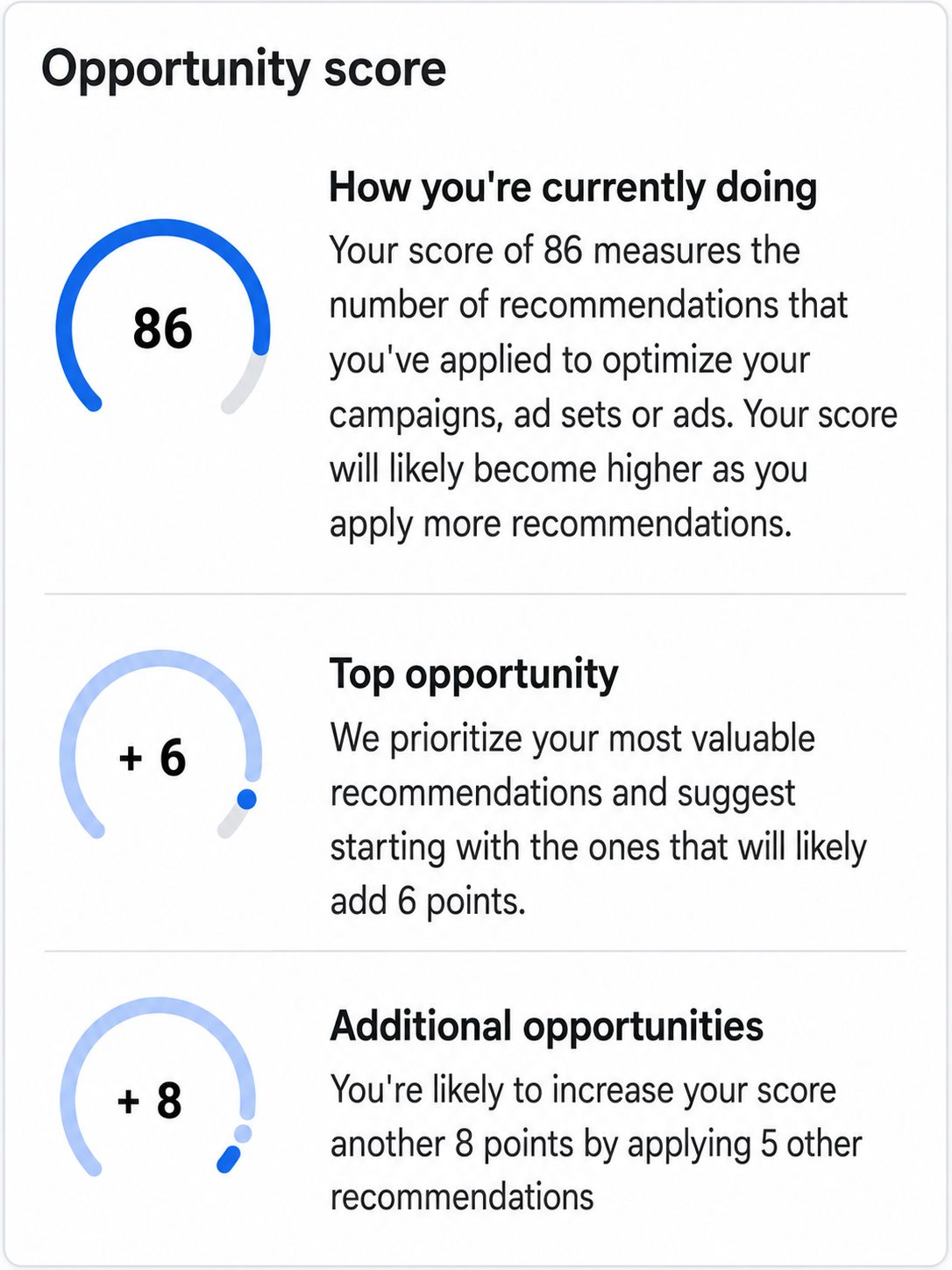
Image source: Meta Ads Manager, Account Overview section
How Automatic Adjustments and Opportunity Score Work Together
Automatic Adjustments and Opportunity Score are closely connected. Opportunity Score highlights Meta’s recommended changes, while Automatic Adjustments allow some of those recommendations to be applied automatically. The score may increase when recommendations are accepted, either manually or automatically.
This can be useful for advertisers who want a faster way to stay aligned with Meta’s best practices. For example, Meta may recommend turning on certain placement options, addressing creative fatigue, broadening audience settings, or making other adjustments based on campaign performance signals.
But advertisers should remember that Meta’s recommendations are based on platform-level signals and estimated performance impact. They do not always understand the full picture behind a campaign. A recommendation may make sense from Meta’s system perspective but still conflict with a client’s business priorities, compliance requirements, budget strategy, creative direction, or sales process.
That is why these tools should support decision-making, not replace it. Strong campaign management still requires human review, especially for brands in more regulated or sensitive industries such as higher education, healthcare, law, finance, housing, employment, or political advertising. For example, special ad categories and platform restrictions can change how campaigns should be structured. Wahl Media has also covered updates like Meta’s credit special ads category expansion, which shows why oversight matters.
Pros of Enabling Meta Automatic Adjustments
Automatic Adjustments can be helpful when used carefully. For busy marketing teams, they can reduce manual review time and surface recommendations that might otherwise be missed. They can also help keep campaigns aligned with current platform preferences, especially as Meta continues to evolve its ad delivery and optimization systems.
They Can Save Time
Manually reviewing every recommendation across multiple campaigns, ad sets, and ads can take time. Automatic Adjustments can help advertisers move faster by applying selected recommendation types without requiring the same level of manual work each time.
This can be especially useful for large accounts or active campaigns with frequent changes. If an account has many campaigns running at once, automation can help reduce some of the day-to-day maintenance work.
They Can Surface Useful Optimization Opportunities
Meta has access to a large amount of campaign performance data. Its recommendations may help advertisers spot potential issues or opportunities, such as creative fatigue, limited delivery, placement restrictions, budget constraints, or setup choices that may be limiting performance.
When recommendations are reviewed thoughtfully, they can support better testing and optimization. They may also help advertisers identify areas that deserve a deeper performance review.
They Can Help Campaigns Stay Aligned With Platform Best Practices
Social media platforms change often. Meta regularly updates how campaigns are delivered, how placements are prioritized, and how its automated tools are used. Automatic Adjustments can help advertisers stay closer to current platform recommendations without needing to track every minor update manually.
This is especially relevant for campaigns that rely on frequent creative testing, paid social optimization, or broader full-funnel media strategy. For more on social creative planning, review our guide to Instagram Reels ads and our post on social media safe zones.
Cons of Enabling Meta Automatic Adjustments
Despite the benefits, Automatic Adjustments should not be turned on blindly. There are risks when any platform is allowed to make changes without understanding the full strategy behind a campaign.
Meta Does Not Know Your Full Business Context
Meta’s system can evaluate campaign signals, but it does not know every business detail that matters. It may not understand client expectations, seasonal priorities, brand guidelines, legal restrictions, lead quality concerns, sales team capacity, or offline conversion value.
For example, Meta may recommend broadening a campaign to increase delivery, but that may not make sense if the advertiser needs a very specific audience. It may recommend a creative or placement adjustment that improves delivery but weakens brand consistency. It may also suggest budget-related changes that do not align with the client’s spend plan.
Recommendations May Prioritize Platform Efficiency Over Business Goals
Meta’s goal is to improve campaign performance based on the signals available inside its system. But better platform efficiency does not always mean better business results. A campaign could generate cheaper leads that are less qualified, broader reach that does not convert, or more engagement that does not support the actual sales goal.
That is why marketers need to look beyond the recommendation itself. The question should not be, “Will this increase the Opportunity Score?” The better question is, “Will this help the campaign reach the right audience and produce the right outcome?”
Automation Can Make It Harder to Identify What Changed
When changes are applied automatically, it can become harder to understand exactly what caused a shift in performance. If results improve or decline after several automated changes, advertisers may need to spend extra time reviewing account history, campaign settings, and performance trends.
This matters because good optimization depends on clear testing. If too many changes happen at once, it becomes harder to isolate what actually made a difference. That can weaken reporting, learning, and long-term campaign planning.
Should Your Business Enable Meta Automatic Adjustments?
The best answer is: it depends on the account, the campaign, and the type of recommendations being applied.
For some advertisers, Automatic Adjustments may be worth testing in controlled ways. For others, it may be better to review Meta’s recommendations manually and apply only the ones that clearly support the campaign strategy. In most cases, businesses should not enable every available adjustment without first understanding what each one can change.
A cautious approach is usually best. Review the available Automatic Adjustments, decide which ones are low-risk, and monitor performance closely after enabling them. If a recommendation could affect targeting, budget, creative, placements, or compliance-sensitive settings, it should be reviewed carefully before being applied.
This is especially important for businesses running campaigns tied to specific locations, sensitive categories, regulated industries, or strict conversion goals. In those cases, automation can still be useful, but it should work inside a clear strategy rather than replacing one.
Best Practices for Reviewing Meta Recommendations
Whether you enable Automatic Adjustments or keep recommendations manual, it is still worth reviewing the Account Overview section of Meta Ads Manager regularly. Meta’s recommendations can provide useful clues, even when you decide not to apply them.
- Review recommendations weekly or during routine campaign optimizations.
- Check what each recommendation will actually change before applying it.
- Prioritize recommendations that align with the campaign objective and business goal.
- Be careful with changes that affect budget, targeting, placements, or creative delivery.
- Document major changes so performance shifts are easier to understand later.
- Do not chase a perfect Opportunity Score if the recommendation does not support the strategy.
- Monitor lead quality, conversion value, and downstream results, not just Meta’s in-platform metrics.
For advertisers managing multiple media channels, Meta recommendations should also be considered alongside other campaign data. Paid social does not exist in a vacuum. Search, display, video, traditional media, landing pages, analytics, and sales follow-up all influence the bigger picture. That is why a balanced campaign strategy is more valuable than platform automation alone.
When You Should Be Extra Careful
There are certain situations where Automatic Adjustments deserve extra caution. If a campaign has a fixed budget, a narrow geographic target, strict brand messaging, legal disclaimers, or a very specific audience, advertisers should review recommendations manually before allowing Meta to apply them.
Brands should also be careful when campaigns are part of a larger media plan. A Meta recommendation might make sense inside Ads Manager, but it could conflict with broader goals across search, video, out-of-home, traditional media, or other digital channels. For businesses investing in a more integrated media mix, reviewing recommendations through a larger strategy lens is essential.
If you are planning across channels, our pages on traditional media, digital media, and research show how different pieces of a campaign can work together.
Final Thoughts on Meta Automatic Adjustments
Meta Automatic Adjustments and Opportunity Score can be useful tools for advertisers, but they should be used with judgment. They can save time, highlight potential improvements, and help campaigns stay aligned with Meta’s evolving best practices. However, they do not replace strategic thinking, client context, creative review, or performance analysis.
The smartest approach is to treat Meta’s recommendations as a starting point. Review them, understand them, and apply the ones that make sense for your goals. If an adjustment supports the campaign strategy, it may be worth testing. If it does not, it is perfectly reasonable to dismiss it.
Automation can help campaigns move faster, but human strategy is what keeps them moving in the right direction.
Frequently Asked Questions About Meta Automatic Adjustments
What are Meta Automatic Adjustments?
Meta Automatic Adjustments are recommendations inside Meta Ads Manager that can be applied automatically when Meta identifies a potential opportunity to improve campaign performance. These adjustments may relate to campaign settings, placements, audiences, creative, or other optimization areas. Advertisers should review what each adjustment can change before enabling it.
What is Meta Opportunity Score?
Meta Opportunity Score is a 0 to 100 point score that reflects how many Meta Ads Manager recommendations have been applied and how valuable Meta estimates those recommendations may be. A higher score means more Meta recommendations have been accepted, but it does not guarantee stronger campaign performance.
Should I turn on all Meta Automatic Adjustments?
Most advertisers should not turn on every Automatic Adjustment without review. Some recommendations may be helpful, while others may not align with the campaign’s audience, budget, creative, compliance needs, or business goals. A controlled, selective approach is usually safer than enabling everything at once.
Does a high Opportunity Score mean my ads are performing well?
No. A high Opportunity Score means your campaigns are more closely aligned with Meta’s current recommendations, but it does not guarantee actual or future performance. Campaign success still depends on factors such as strategy, offer, creative quality, audience, landing page experience, budget, tracking, and lead quality.
How often should advertisers review Meta recommendations?
Advertisers should review Meta recommendations regularly, especially during weekly optimizations or campaign performance checks. Even if Automatic Adjustments are not enabled, the recommendations can highlight potential issues or areas to test. The key is to evaluate each recommendation against the campaign’s real business goals.
If your team needs help deciding which Meta recommendations are worth applying and which should be ignored, reach out to Wahl Media. We can help connect paid social strategy, creative, media planning, and performance analysis into a campaign that is built around your goals, not just a platform score.